
The Zero-Downtime Imperative
In the modern digital landscape, the cost of downtime is no longer just lost revenue but also lost trust. As organizations transition toward continuous delivery, the traditional "maintenance window" in which services go dark for hours while engineers scramble to update code is fast becoming a relic of the past.
Among the various strategies available to modern engineering teams, Blue-Green Deployment stands out. Due to its nature, it is often one of the most effective methods for ensuring high availability. As a result, it provides a safety net that allows teams to push new features with the confidence that they can "flick a switch" to go live. Furthermore, it also allows for quick recall in case something goes wrong. This article explores the nuances of this strategy, how it fits into the broader scope of Deployment in DevOps, and why it remains a gold standard for enterprise-level releases.
What is Blue-Green Deployment?
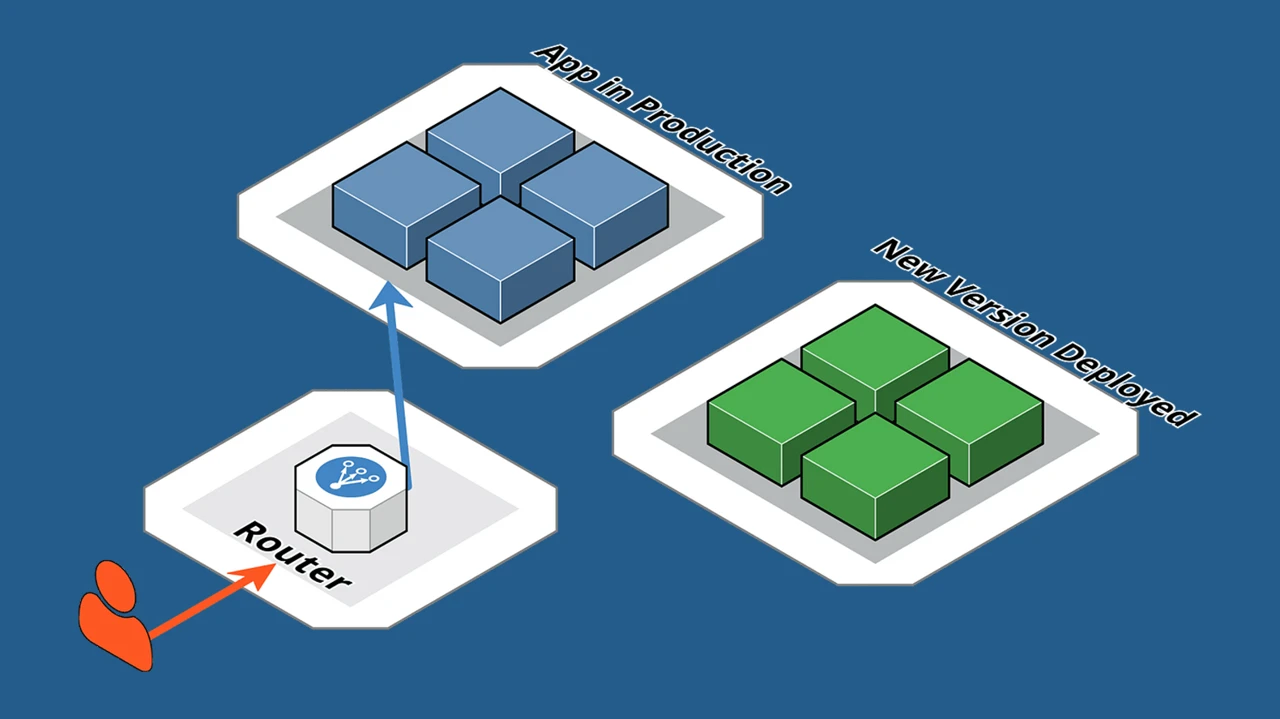
At its core, Blue-Green deployment is a release management strategy that utilizes two identical production environments.
- The Blue Environment: This is the current "live" production environment handling all active user traffic.
- The Green Environment: This is a replica of Blue, serving as the staging area where the new version of the software is deployed and tested.
The magic happens at the router or load balancer level. Once the Green environment is fully tested and verified, traffic is rerouted from Blue to Green. Instantly, Green becomes the new live environment, and Blue becomes the idle standby.
The Philosophy of Redundancy
Unlike "rolling updates," where pieces of an application are swapped out incrementally, Blue-Green treats the entire environment as an immutable object. Additionally, by keeping the old version (Blue) alive even after the new version (Green) goes live, you create an instantaneous rollback mechanism. If a critical bug is discovered five minutes after the launch, you don't need to patch code under pressure. You point the load balancer back to Blue.
Blue-Green vs. Other Deployment Types
To truly understand the value of Blue-Green, we must examine how it differs from other popular strategies in Deployment within DevOps.
1. Blue-Green vs. Canary Deployment
While Blue-Green flips 100% of traffic at once, Canary Deployment introduces the new version to a small subset of users first (e.g., 5%). As a result, traffic is shifted incrementally based on performance metrics.
- Winner for Safety: Canary (it limits the "blast radius" of bugs).
- Winner for Speed: Blue-Green (the transition is immediate for all users).
2. Blue-Green vs. Rolling Updates
In a Rolling Update, servers in a cluster are updated one at a time. As a result, this saves on infrastructure costs (you don't need a full duplicate environment). However, it often leads to "version skew," where some users are on Version 1 while others are on Version 2.
- Winner for Consistency: Blue-Green (everyone switches to the same version simultaneously).
3. Blue-Green vs. A/B Testing
A/B testing is often confused with deployment strategies, but it is actually a functional experiment. It routes traffic based on user demographics or behavior to see which version performs better from a business perspective. That is why Blue-Green is focused on deployment reliability, not the UI conversion rate.
The Step-by-Step Blue-Green Process
Implementing a Blue-Green strategy requires a disciplined approach to automation and infrastructure. Here is the typical lifecycle:
Step 1: Prepare the Green Environment
The DevOps team clones the existing Blue environment. Additionally, using Infrastructure as Code (IaC) tools like Terraform or Pulumi, this process is automated. As a result, it ensures that the Green environment is a "twin" of Blue in terms of hardware, networking, and configuration.
Step 2: Deploy to Green
The new version of the application has been deployed to the Green environment. Furthermore, since Green is not receiving any live traffic, this stage is completely "dark." As a result, engineers can perform smoke tests, integration tests, and performance benchmarks without impacting a single customer.
Step 3: The Switch (Cutover)
Once the Green environment is deemed stable, the load balancer or DNS configuration is updated. As a result, within milliseconds, all incoming requests are directed to the Green environment.
Step 4: Monitoring and Observation
Now that Green is live, the SRE (Site Reliability Engineering) team monitors it closely. They look for spikes in error rates, latency, or memory leaks. Furthermore, these issues may not appear during initial testing.
Step 5: Decommission or Standby
If the deployment is successful, the Blue environment remains idle for a specified "soak period." Eventually, it can be decommissioned to save costs, or it can become the "Green" environment for the next release cycle.
Key Benefits of Blue-Green Deployment
1. Near-Zero Downtime
Because the switch happens at the routing layer, users experience no "Service Unavailable" messages. As a result, the transition is seamless, making it ideal for 24/7 global services.
2. Instant Rollback
The primary source of anxiety for developers is a failed release. With Blue-Green, the "Undo" button is built in. That is why, reverting to the previous stable state is as simple as re-configuring the load balancer.
3. Isolated Testing in Production-Grade Environments
Testing in a staging environment that "looks like" production is never the same as testing in the actual production environment. As a result, Blue-Green allows final verification on the same hardware and network stack that users will eventually use.
4. Simplified Capacity Planning
Since you are maintaining two environments, you need to ensure your infrastructure is reproducible. Furthermore, this matures the organization’s DevOps practices and makes scaling much easier in the long run.
The Role of Quality Assurance
While Blue-Green deployment provides the infrastructure for a safe release, the strategy is only as good as the tests that validate the "Green" environment before the switch. Without rigorous testing, you risk simply switching your users over to a broken, albeit beautifully deployed version of your app.
Real-World Examples
Amazon Web Services (AWS)
AWS is a pioneer of this strategy. Using services like AWS CodeDeploy and Route 53, Amazon allows developers to automate traffic shifting between environments. This is how they manage thousands of deployments per day across their global infrastructure without the internet ever noticing a hiccup.
Netflix
Netflix utilizes a variation of Blue-Green to manage its microservices architecture. When they update a service, they spin up a new cluster of instances. They use "Red-Black" (their terminology for Blue-Green) to ensure that if a new video-streaming logic fails, they can instantly revert to the old logic, keeping the "Play" button working for millions of viewers.
Financial Institutions
Traditional banks moving to the cloud use Blue-Green to comply with strict regulatory requirements. Since they cannot afford even a minute of downtime for transaction processing, the ability to verify a "Green" environment before making it live is a critical compliance checkbox.
Challenges and Best Practices
Despite its advantages, Blue-Green deployment is not a "silver bullet." It comes with specific hurdles:
- Database Schema Changes: This is the biggest challenge. If the Green version requires a new database column that Blue doesn't support, a simple rollback becomes impossible. That is why, the solution is to use "Expand and Contract" patterns, where database changes are made backward-compatible.
- Infrastructure Costs: Maintaining two identical environments can double your cloud bill. However, with the rise of Serverless and Containerization (Kubernetes), you can spin up the Green environment only when needed and tear it down after the switch.
- Stateful Sessions: If users are logged into the Blue environment, switching them to Green might log them out. Implementing "Session Affinity" or using a centralized session store (such as Redis) is essential to maintaining a smooth user experience.
Conclusion
Blue-Green deployment represents a shift in mindset from "recovering from failure" to "designing for resilience." By decoupling code deployment from feature releases, organizations can move faster while significantly reducing the risk of catastrophic outages. It is a cornerstone of any mature Deployment in the DevOps framework, providing the perfect balance between speed and stability.
As you look to evolve your delivery pipeline, remember that the goal isn't just to ship code—it's to deliver value without interruption. By mastering the Blue-Green process, managing database synchronization, and leveraging robust automation tools, your team can transform deployment day from a high-stress event into a non-event. The future of software is always live, and Blue-Green is how you keep it that way. Streamline your QA with Hulhub DevOps to ensure that every transition from Blue to Green has the seal of approval from data-driven confidence and automated precision.