
Difference Between M-Commerce and E-Commerce?
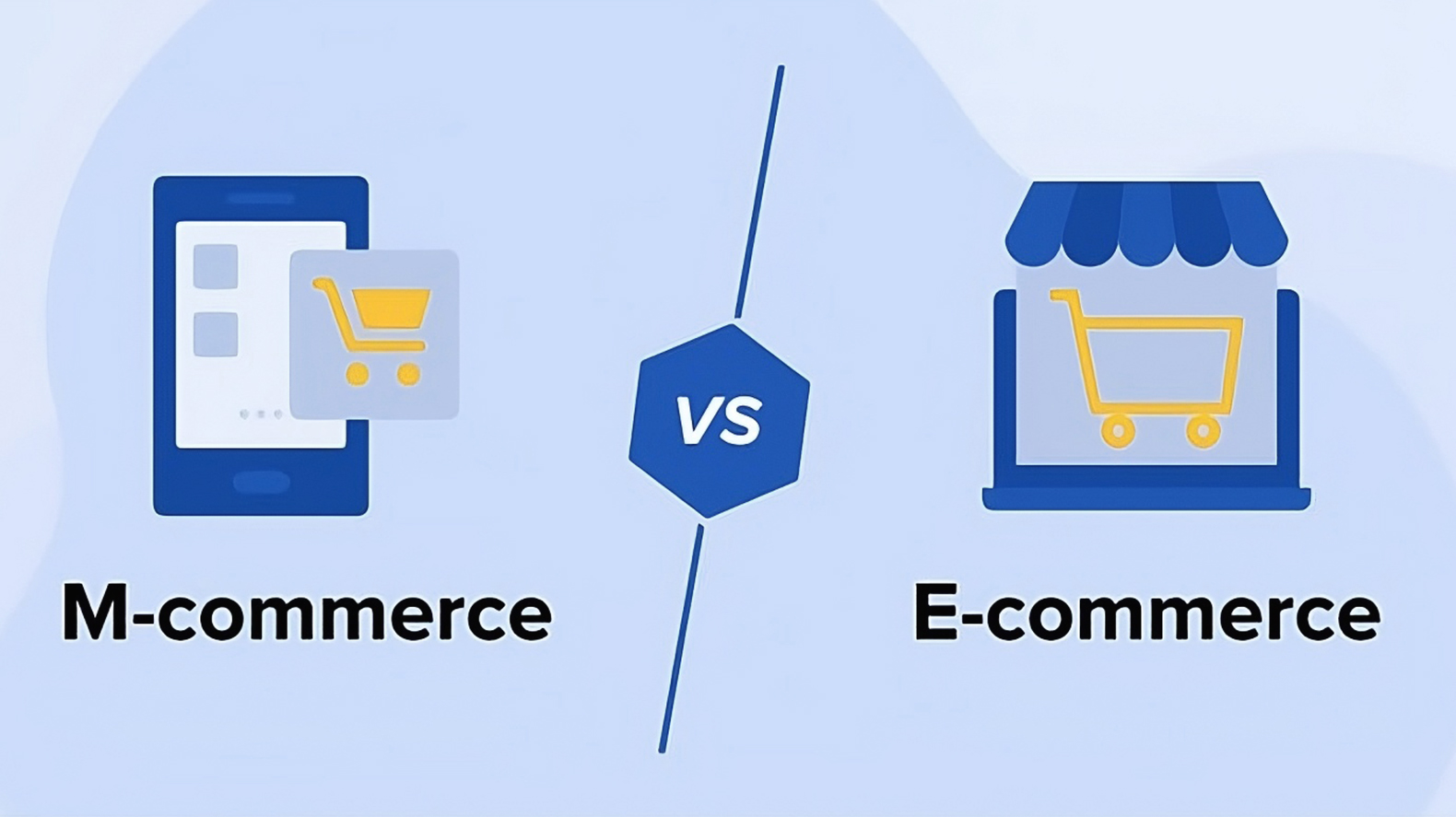
The digital marketplace has come a long way from the humble "website." Today, business owners must navigate a landscape where the device a customer uses defines their entire shopping journey. Although they are often used interchangeably, Electronic Commerce (E-Commerce) and Mobile Commerce (M-Commerce) represent distinct philosophies.
As 2026 rolls in, understanding these nuances is no longer just for tech enthusiasts. It is a foundational requirement for any commerce venture looking to scale. Whether you are a startup or an established retailer, the choice between optimizing for desktop or doubling down on mobile will determine the trajectory of your conversion rates and your customer loyalty.
Defining the Contenders: E-Commerce vs. M-Commerce
At its core, E-Commerce is the overarching umbrella. It refers to any commercial transaction conducted online. Furthermore, historically, this meant a user sitting at a desk, opening a laptop, and browsing a website.
M-Commerce, however, is a specialized subset of E-Commerce. Additionally, it specifically involves transactions made on handheld wireless devices, such as smartphones and tablets. While all M-Commerce is E-Commerce, not all E-Commerce is "mobile."
Why This Distinction Matters for Your Venture
The hardware dictates the software. A desktop user has a large screen, a physical keyboard, and likely a stable fiber-optic connection. They are often in a "research" mindset. It means that they would be comparing technical specs or reading long-form reviews. In contrast, a mobile user is often on the go, seeking "instant" gratification, and navigating with a single thumb. If you treat a mobile user like a desktop user, you are likely to lose them in seconds.
1. Mobility and Accessibility: The "Anywhere" Advantage
The most glaring difference is mobility. E-Commerce ties the user to a location, such as a home office, a café, or a library. While laptops are portable, they aren't "active." You rarely see someone browsing a laptop while waiting in line for coffee or riding the subway.
M-Commerce thrives in these "micro-moments."
The Reach: M-Commerce allows your brand to be in the customer’s pocket 24/7.
The Logic: This fits a commerce venture that relies on impulsive buys or time-sensitive offers. As a result, if your product is a daily necessity or a lifestyle accessory, M-Commerce is your primary engine because it captures users when the need arises.
2. Security Protocols and Biometrics
Security is the silent pillar of digital trust. In traditional E-Commerce, security often relies on Cloud Computing Security Architecture to protect server-side data and on browser-level encryption (SSL/TLS). Users typically enter credit card details and passwords. However, it is a process that is prone to friction and "form fatigue."
M-Commerce elevates this through biometric authentication. By utilizing:
1. Face ID/Fingerprint Scanners: These reduce the need for remembering passwords.
2. Two-Factor Authentication (2FA): Integrated directly into the device.
3. Tokenization: Mobile wallets (Apple Pay, Google Pay) never share the actual card numbers with merchants.
For your venture, M-Commerce offers a "frictionless" trust. A user is more likely to complete a purchase if they can authorize it with a thumbprint rather than digging through their wallet for a physical card.
3. Localization and Geofencing: The Power of GPS
E-Commerce can determine a user's location based on their IP address, which is often vague. M-Commerce, however, utilizes GPS, Wi-Fi, and Bluetooth to pinpoint a user’s exact location.
How Geofencing Fits Your Business
Imagine a customer walking within 500 meters of your physical storefront. An M-Commerce app can trigger a push notification with a 10% discount code valid for the next hour. This "contextual commerce" is impossible on a desktop.
Direct impact: It bridges the gap between digital browsing and physical foot traffic.
Personalization: You can offer region-specific products (e.g., promoting umbrellas to users in a city where it’s currently raining).
4. User Interface (UI) and Experience (UX)
The design philosophy for these two platforms is night and day.
E-Commerce (Desktop): Can afford "horizontal" layouts, sidebars, and multi-step checkouts. It’s built for exploration.
M-Commerce (Mobile): Must follow the "Rule of Thumb." Buttons must be large, navigation must be "vertical," and the checkout should ideally be a single click.
If your venture sells complex products (like enterprise software or industrial machinery), the desktop's ability to display detailed comparison tables is a strength. However, for retail, fashion, and food, the streamlined mobile UX wins every time.
5. Technical Infrastructure: Cloud and Beyond
Underpinning both models is a robust Cloud Computing Security Architecture . This architecture ensures that whether a user hits your site from a MacBook or an iPhone, their data is encrypted, and the server can handle the load.
Why the Cloud is Your Backbone
The cloud allows for auto-scaling . During a Black Friday surge, a cloud-native architecture automatically scales up to prevent your mobile app from crashing. It also provides the "High Availability" that M-Commerce users expect, ensuring the app works instantly regardless of their location. For a growing venture, investing in a cloud-first infrastructure means you don't have to worry about outgrowing your hardware.
6. Omnichannel Integration: The Hybrid Future
One of the most significant shifts in 2026 is the blurring of lines between the two platforms, creating what is known as Omnichannel Commerce . While E-Commerce and M-Commerce have different technical requirements, they must share a single "brain."
For your commerce venture, this means a customer should be able to add an item to their cart on a desktop at work (E-Commerce) and find it waiting in their mobile app during their commute (M-Commerce). To achieve this, you need to explore mobile app development solutions that prioritize cross-platform synchronization.
By integrating your inventory and customer data into a unified backend, you ensure that the "conversation" with your customer never resets. This approach works because it respects the customer's time and device choice, significantly reducing the drop-off rates often seen when moving between platforms.
7. Communication Channels: Email vs. Push Notifications
In E-Commerce, the primary way to bring a customer back is Email Marketing . While effective, emails often sit in "Promotions" tabs for hours or days.
M-Commerce introduces Push Notifications . These have an open rate significantly higher than email because they appear directly on the lock screen.
The Strategy: Use push notifications for "Flash Sales" or "Cart Abandonment" reminders.
The Caution: Overusing them can lead to app uninstalls. The key is to provide value (e.g., "Your order has shipped!") rather than just noise.
Conclusion: Synthesizing the Strategy
The "Difference between M-Commerce and E-Commerce" isn't just about the screen size; it's about intent and environment.
E-Commerce is your "flagship store.” The place for deep dives, detailed research, and broad browsing. It provides the stability and space required for high-consideration purchases.
M-Commerce is your "express lane.” The tool for convenience, speed, and hyper-personalized engagement. It leverages the smartphone's unique hardware to turn every spare minute of a consumer's day into a potential transaction.
For a modern commerce venture, the answer isn't "one or the other." It is a Mobile-First approach supported by a robust desktop presence. The real winners in the 2026 market are those who recognize that the smartphone is the primary remote control for a consumer's life, while the desktop remains the hub for complex decision-making.
By leveraging the latest in Cloud Computing Security Architecture to protect user data and implementing biometric tech to speed up checkout, you can create a safe, seamless environment for your customers across all touchpoints. This dual-pronged strategy ensures you capture both the impulsive mobile shopper and the methodical desktop researcher.